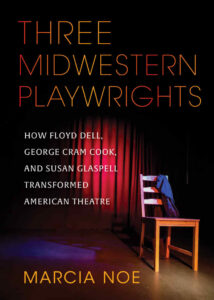
 Marcia Noe’s impressive career as a Glaspell scholar began in 1983 with her publication of the first modern biography of Susan Glaspell, Susan Glaspell: Voice from the Heartland (Western Illinois University Press). Over the intervening years Noe contributed many feminist and formalist analyses of Glaspell’s plays, often illuminating their context in Midwestern culture. This body of work is now crowned with her publication of Three Midwestern Playwrights: How Floyd Dell, George Cram Cook, and Susan Glaspell Transformed American Theatre, which tells a part of the Provincetown story that has not yet been told.
In this book Noe argues that the progressive social, political, and cultural activities in which Floyd Dell, George Cram Cook, and Susan Glaspell were involved in early twentieth-century Davenport, Iowa, informed not only the plays that they wrote but also the aesthetic and theatre practice of the Provincetown Players (1915-1922), the theatre company that contributed significantly to the foundation of modern American drama. The philosophical and political orientations of Dell, Cook, and Glaspell, fostered in their Midwestern hometown, helped to create a theatre practice marked by experimentalism, collaboration, leftist cultural critique, rebellion, liberation, and community engagement.
This book situates the origin of the Provincetown aesthetic in Davenport, Iowa, a Mississippi River town in which a large German population provided a particularly fertile cultural environment, including a Socialist local in which Dell and Cook were active. In addition to their political activities, Noe establishes that Dell’s work as reporter and editor for The Tri-City Workers Magazine, Dell’s and Cook’s leadership in the Monist Society, and Cook and Glaspell’s role in the Davenport censorship controversy were reflected in the plays that they wrote for the Provincetown Players. She discusses how all three writers were able to see that radical politics sometimes begets radical chic and shows how, consequently, several of their plays satirize the faddish elements of the progressive political, social, and cultural movements in which they were active.
Although the Provincetown Players was located on the East Coast, several of Dell’s, Cook’s, and Glaspell’s plays were set in their native Midwest. Noe’s new book tells the story of how Dell, Cook, and Glaspell effected a marriage between early twentieth-century Midwestern radicalism and East Coast avant-garde theatre practice, a marriage that resulted in a fresh and energetic contribution to American theatre.
 With this new book in the Iowa and the Midwest Experience series, Patricia L. Bryan and Thomas Wolf add to their already indispensable legal/historical work relevant to Glaspell’s oeuvre, which began with Midnight Assassin: A Murder in America’s Heartland (Chapel Hill, 2005), their exhaustive study of the Margaret Hossack case upon which Glaspell based Trifles / “A Jury of Her Peers”. The Plea: The True Story of Young Wesley Elkins and His Struggle for Redemption tells the story of 11-year-old Wesley’s crime in Iowa in 1889—the murder of his abusive father and stepmother—and his incarceration as a child in an adult prison. During the next twelve years, he educated himself, argued eloquently for his release, and won the support of prison wardens, educators, newspaper editors, and politicians. For Bryan and Wolf, it is a story of heroic perseverance and an exploration of the social, political, and legal systems of the era.


 Edited by ISGS and Eugene O’Neill Society members and theater scholars Drew Eisenhauer and Brenda Murphy, this anthology provides a wide range of new essays on such diverse American dramatists as Eugene O’Neill, Susan Glaspell, Thornton Wilder, Arthur Miller, Maurine Dallas Watkins, Sophie Treadwell, and Washington Irving. The essayists offer numerous approaches to intertextuality: the influence of the poetry of romanticism and Shakespeare and of histories and novels, ideological and political discourses on American playwrights, unlikely connections between such writers as Miller and Wilder, the problems of intertexts in translation, the evolution in historical and performance contexts of the same tale, and the relationships among feminism, the drama of the courtroom, and the drama of the stage. The anthology includes the following new essays on Glaspell’s work:
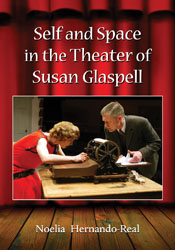 Published by McFarland, Noelia Hernando-Real’s exploration of eleven Glaspell plays written between 1915 and 1943 focuses on one of her major themes, the interplay between place and identity. Hernando-Real examines the means Glaspell employs to engage her characters in proxemical and verbal dialectics with the forces of place that turn them into victims of location, and her characters’ attempts to escape the influence of territoriality and shape identities of their own.


